


This collection of 25 powerful Bible verses about friendship goes beyond a simple list. Each verse comes with its meaning and context, so you can understand who was speaking, what situation they were in, and why those words still matter today. A verse read on its own can sound like a quick quote, but placed in its original setting, it often reveals a much deeper message about loyalty, sacrifice, forgiveness, and love.
Few things shape our lives like the people we choose to walk beside. A faithful friend can lift you when you fall, speak truth when you need it, and remind you of God’s promises when your own faith feels weak. The Bible understands this deeply, and from Genesis to the New Testament, it returns again and again to the power of true friendship.
What Does the Bible Say About Friendship?

Friendship is one of the most meaningful themes in Scripture. From the loyal bond between David and Jonathan to the words of Jesus calling His followers friends, the Bible shows that God values deep, faithful relationships. It teaches that a true friend loves at all times, speaks honestly, offers comfort in hard seasons, and sticks closer than a brother.
Scripture also reminds us that friendship is more than companionship. Good friends sharpen one another, carry each other’s burdens, and point each other toward God. At the same time, the Bible warns about the influence of the wrong company, encouraging believers to choose friends who build them up rather than pull them down.
Whether you are looking for guidance on loyalty, forgiveness, encouragement, or wisdom in choosing the right people, the Bible offers timeless truth. Understanding what Scripture says about friendship can help you become a better friend and recognize the kind of friends worth keeping.
Bible Verses About True Friendship
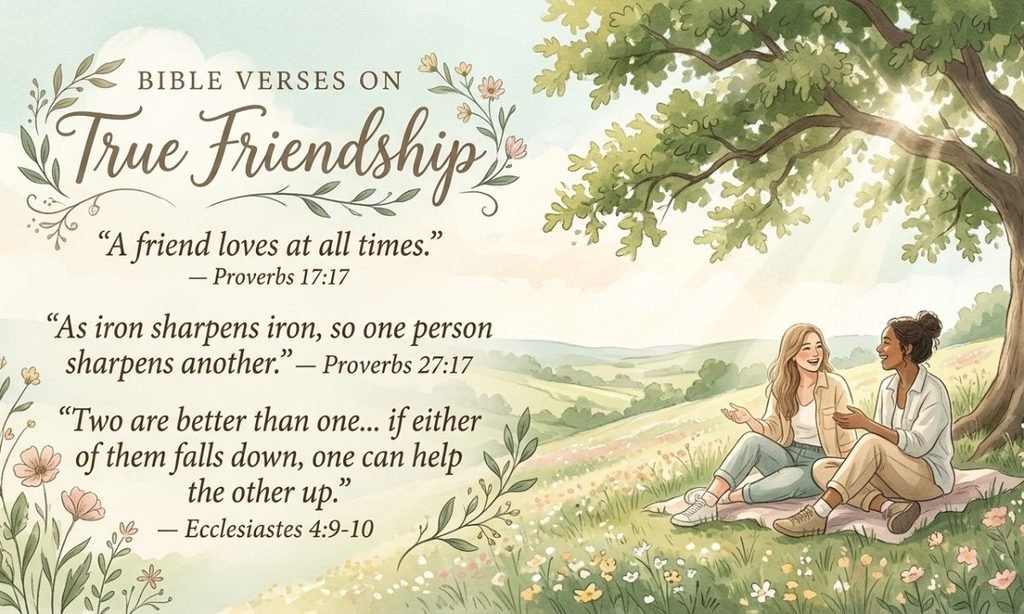
True friendship is tested in difficult moments, and the Bible is full of verses that show what real, God-honoring friendship looks like. These passages speak about steady loyalty, sacrificial love, honest counsel, and the joy of walking through life with people who care for your heart and your faith.
Proverbs 17:17 Steady Love
Verse (NIV): “A friend loves at all times, and a brother is born for a time of adversity.”
Meaning: True friendship is not seasonal. A real friend’s love stays steady in good times and bad, and it often shows most clearly when life becomes hard. The verse also pairs friendship with family, suggesting that a faithful friend can be as dependable as a brother in a crisis.
Context: Proverbs is a book of practical wisdom, largely attributed to Solomon, written to teach people how to live wisely in relationships, work, and character. This verse sits among short sayings that contrast reliable love with shallow, convenient connections. The original audience would have understood that loyalty in hardship was the real test of a friend.
Application: Be the friend who shows up when it is inconvenient. Check in on someone who is struggling, stay when others drift away, and let your love be consistent rather than dependent on how easy the friendship feels.
Ecclesiastes 4:9-10 Help When You Fall
Verse (NIV): “Two are better than one, because they have a good return for their labor: If either of them falls down, one can help the other up. But pity anyone who falls and has no one to help them up.”
Meaning: Life is meant to be shared. Companionship brings strength, support, and rescue in moments of failure or weakness. The passage shows that having someone beside you makes burdens lighter and setbacks easier to recover from.
Context: Ecclesiastes is a reflective book often linked to Solomon, exploring what makes life meaningful. Just before this passage, the writer describes a person who works alone with no companion and finds the toil empty. Verses 9-10 offer the contrast: shared effort and shared support give life purpose and protection.
Bible Verses About Loyal Friends

Loyalty is the quiet strength of every lasting friendship. The Bible celebrates friends who stay faithful in hard times, keep their promises, and stand firm when it costs them something. These verses show what real devotion looks like, from the covenant bond between David and Jonathan to Ruth’s steadfast commitment to Naomi. Read them to be encouraged by the loyal friends in your life, and to learn how to be one yourself.
Proverbs 18:24 A Friend Closer Than a Brother
Verse (NIV): “One who has unreliable friends soon comes to ruin, but there is a friend who sticks closer than a brother.”
Meaning: Having many friends does not guarantee real friendship. Some people are only around when things are easy, and relying on them can lead to disappointment or harm. The verse points to a rarer kind of friend, one whose loyalty is so steady that it can feel even stronger than family ties.
Context: This proverb belongs to Solomon’s collection of wisdom sayings, which often contrast shallow and genuine relationships. The Hebrew wording of the first line is debated, and some translations read it as a person who has many companions “may be harmed by them” or “pretends to be friends.” Either way, the message is the same: quality matters more than quantity. Many Christians also see in the second line a picture of Jesus, the friend who never leaves His people.
Application: Invest in a few deep, faithful friendships rather than chasing a large circle of casual ones. Be careful about who you trust with your heart, and strive to be the kind of friend who stays close when others step back.
Bible Verses About Wise Friendships

The people we spend time with shape who we become, and the Bible takes that truth seriously. Scripture encourages us to choose friends who value wisdom, speak honestly, and draw us closer to God, while warning against company that leads us astray. These verses offer practical guidance for building friendships that sharpen your character, strengthen your faith, and help you walk wisely.
Proverbs 27:17 Iron Sharpens Iron
Verse (NIV): “As iron sharpens iron, so one person sharpens another.”
Meaning: Good friends make each other better. Just as one piece of iron sharpens another through friction, honest and engaged friendships challenge us to grow in character, wisdom, and faith. Growth sometimes comes through healthy disagreement and loving correction.
Context: This proverb is part of Solomon’s collection of sayings on relationships. In the ancient world, metal tools and blades needed regular sharpening to stay useful. The image shows that people are shaped by those closest to them, for better or worse.
Application: Seek friends who encourage you to grow, not only those who always agree with you. Be willing to offer and receive gentle, honest feedback.
Proverbs 13:20 Walk With the Wise
Verse (NIV): “Walk with the wise and become wise, for a companion of fools suffers harm.”
Meaning: Wisdom is contagious, and so is foolishness. The people we walk with regularly influence our habits, choices, and outlook. Spending time with wise friends leads to growth, while close ties with those who reject wisdom can lead to harm.
Context: In Proverbs, “fool” does not mean unintelligent. It describes someone who ignores God’s guidance and good counsel. The verse reflects a core theme of the book: your companions help determine your path.
Application: Look honestly at your closest influences. Spend more time with people who live with integrity and faith, and ask whether your friendships are moving you toward wisdom or away from it.
Proverbs 22:24-25 Choose Companions Carefully
Verse (NIV): “Do not make friends with a hot-tempered person, do not associate with one easily angered, or you may learn their ways and get yourself ensnared.”
Meaning: Character is learned from those around us. Close friendship with someone who is constantly angry can slowly shape your own temper and reactions, eventually trapping you in the same patterns.
Context: This passage appears in the “Sayings of the Wise” section of Proverbs, which offers direct, practical instruction, much like a parent advising a child. The warning is not about avoiding people who struggle, but about being careful whom you choose as close companions.
Application: Show kindness to everyone, but be careful about whom you allow to deeply influence you. If a friendship is pulling you toward anger or bitterness, set healthy boundaries and seek wise support.
Proverbs 15:22 Seek Honest Counsel
Verse (NIV): “Plans fail for lack of counsel, but with many advisers they succeed.”
Meaning: Wise decisions are rarely made in isolation. Seeking advice from trustworthy, experienced people protects us from blind spots and costly mistakes. Humility in asking for counsel is a sign of wisdom, not weakness.
Context: Proverbs repeatedly values listening and learning. This verse fits the book’s larger teaching that the wise person welcomes advice, while the foolish person trusts only their own judgment.
Application: Before major decisions, talk with godly, honest friends or mentors, especially those who will tell you the truth rather than only what you want to hear.
Why Accountability Matters in Christian Friendship?
Accountability is one of the greatest gifts a friend can give. The Bible teaches that we are not meant to grow alone. Friends who know our struggles and goals can encourage us when we are weak, correct us when we drift, and celebrate with us when we grow. Galatians 6:2 calls believers to carry one another’s burdens, and James 5:16 encourages confessing our faults to one another so we may be healed.
Healthy accountability is built on love, trust, and humility, not judgment or control. A good accountability friend listens without condemning, speaks truth with gentleness, and prays faithfully. In a world that often pushes independence, godly accountability protects your heart, strengthens your faith, and keeps you walking in the direction God is leading you.
Bible Verses About Love and Friendship

Love is the foundation of every friendship that lasts. The Bible teaches that real friendship is more than shared interests or good company. It is patient, kind, and willing to sacrifice for the good of another. From the words of Jesus about laying down one’s life for friends to the call to love one another deeply, these verses show how God’s love shapes the way we care for the people closest to us.
John 15:12 Love as Jesus Loves
Verse (NIV): “My command is this: Love each other as I have loved you.”
Meaning: Jesus sets the standard for love, and it is far higher than convenience or affection. He asks His followers to love with the same patience, humility, and self-giving care He showed them. Friendship among believers is meant to reflect His example.
Context: Jesus spoke these words to His disciples during the Last Supper discourse, shortly before His arrest and crucifixion. He had just washed their feet and taught them about remaining in Him like branches in a vine. The command to love is the fruit of that close connection to Him.
Application: Ask how Jesus would treat your friend in this situation, then act accordingly. Forgive quickly, serve humbly, and love even when it is difficult.
John 15:13 Sacrificial Love
Verse (NIV): “Greater love has no one than this: to lay down one’s life for one’s friends.”
Meaning: The highest form of friendship is love that gives, even at great cost. Laying down one’s life can mean literal sacrifice, but it also includes daily choices to put another person’s good ahead of your own comfort, time, or pride.
Context: Jesus said this just after commanding His disciples to love one another. Within hours, He would demonstrate it by going to the cross. The verse points both to the way He loves His people and to the kind of love His followers are called to show.
Application: Look for small, practical ways to sacrifice for your friends: your time, your attention, your resources, or your preferences. Real love is often shown in quiet, unseen acts.
John 15:15 Jesus Calls His Disciples Friends
Verse (NIV): “I no longer call you servants, because a servant does not know his master’s business. Instead, I have called you friends, for everything that I learned from my Father I have made known to you.”
Meaning: Jesus invites His followers into a relationship of closeness and trust. A servant simply follows orders, but a friend is brought into the heart and purposes of the one they love. God does not only rule over His people; He welcomes them.
Context: This statement comes in the same Upper Room teaching as verses 12 and 13. Jesus had shared with His disciples what the Father had revealed to Him, treating them as trusted companions rather than hired help.
Application: Remember that your relationship with God is personal, not just dutiful. Let that security shape how you treat others, with openness, honesty, and trust.
Romans 12:10 Honor One Another
Verse (NIV): “Be devoted to one another in love. Honor one another above yourselves.”
Meaning: Genuine friendship combines warm affection with deep respect. Believers are called to be devoted, like family, while also valuing others more highly than themselves. Honor means celebrating your friend’s worth, not competing with them.
Context: Paul wrote this in his letter to the church in Rome, in a section describing what a life shaped by God’s mercy looks like. These verses focus on sincere love, humility, and shared life within the Christian community.
Application: Speak well of your friends, celebrate their successes without jealousy, and listen as much as you speak. Put their needs and dignity first.
1 Peter 4:8-10 Love, Hospitality and Service
Verse (NIV): “Above all, love each other deeply, because love covers over a multitude of sins. Offer hospitality to one another without grumbling. Each of you should use whatever gift you have received to serve others, as faithful stewards of God’s grace in its various forms.”
Meaning: Deep love forgives faults and keeps friendships strong. This passage also shows that love is practical: it opens the home, shares gifts, and serves without complaint. Friendship grows through generous, ordinary acts of care.
Context: Peter wrote to Christians scattered across Asia Minor who faced hardship and pressure. He urged them to stay united, because close, loving community would help them endure difficult times.
Application: Overlook minor offenses, invite someone into your home or your time, and use your talents to bless your friends, cheerfully and without keeping score.
Love Is the Foundation of Biblical Friendship
Throughout Scripture, love is the root from which every healthy friendship grows. Without it, companionship becomes shallow and easily broken. With it, friends can forgive, sacrifice, and stay faithful through every season.
The Bible shows that this love begins with God. We love because He first loved us, and His love gives us the pattern and the power to love others well. Biblical friendship, then, is more than affection. It is a commitment to seek the good of another, to honor them, to serve them, and to point them toward Christ. When love leads, friendship becomes a living picture of God’s care for His people.
Bible Verses About Encouraging Friends

A kind word at the right moment can restore hope, steady a weary heart, and remind someone they are not alone. The Bible calls believers to build one another up, speak life into hard seasons, and walk beside those who are struggling. These verses show how friends can strengthen each other’s faith, lighten heavy burdens, and keep moving forward together with courage and joy.
1 Thessalonians 5:11 Build One Another Up
Verse (NIV): “Therefore encourage one another and build each other up, just as in fact you are doing.”
Meaning: Encouragement is a shared responsibility, not a gift reserved for a few. Believers are called to strengthen one another with words and actions that renew hope and deepen faith. Paul also affirms what the Thessalonians were already doing, showing that praise itself is a form of encouragement.
Context: Paul wrote to a young church facing persecution and uncertainty about the return of Christ. Just before this verse, he explained that believers can live with confidence in God’s salvation. Encouragement was meant to help them stay steady while they waited.
Application: Send the message, make the call, or say the kind word you have been meaning to share. Notice what your friends are doing well and tell them.
Galatians 6:2 Share the Burden
Verse (NIV): “Carry each other’s burdens, and in this way you will fulfill the law of Christ.”
Meaning: Christian friendship means stepping into someone else’s struggle rather than watching from a distance. Burdens can include grief, stress, temptation, or hardship, and sharing them makes them lighter. Paul says this kind of care reflects the heart of Christ’s teaching, which is love.
Context: Paul wrote this to the churches in Galatia, urging them to treat one another with gentleness, especially when someone had stumbled. The verse follows his instruction to restore others humbly, not with pride or judgment.
Application: Ask a friend how you can truly help, then follow through with your time, prayers, or practical support. Let trusted friends carry some of your load as well.
Hebrews 10:24-25 Encourage Love and Good Works
Verse (NIV): “And let us consider how we may spur one another on toward love and good deeds, not giving up meeting together, as some are in the habit of doing, but encouraging one another, and all the more as you see the Day approaching.”
Meaning: Believers grow best in community. Regular time together helps friends motivate one another toward love and good deeds, and it keeps faith from fading in isolation. The verse treats encouragement as something to plan and pursue, not leave to chance.
Context: The letter to the Hebrews was written to Christians under pressure, some of whom were tempted to withdraw or abandon their faith. The author urged them to hold on to hope and to stay connected, especially as difficulties increased.
Application: Make time for gatherings, prayer, and honest conversation with fellow believers. Think intentionally about how you can inspire your friends toward kindness and generosity.
Romans 15:2 Help Another Person Grow
Verse (NIV): “Each of us should please our neighbors for their good, to build them up.”
Meaning: True friendship looks beyond what is easy or flattering and seeks the real good of the other person. Pleasing a friend here does not mean telling them only what they want to hear. It means acting in ways that strengthen their character and faith.
Context: Paul wrote to the church in Rome, where believers from different backgrounds disagreed over customs and convictions. He urged the stronger to bear with the weaker and to follow the example of Christ, who did not live for His own comfort.
Application: Before you speak or act, ask whether it will help your friend grow. Offer patience, honest support, and encouragement that points them toward what is good.
Encouragement Is an Expression of Christian Love
Encouragement is love put into words and action. It does not ignore pain or pretend problems are small. Instead, it sits with people in difficulty and gently points them back to hope, to God’s promises, and to their own worth in His eyes.
The Bible shows that encouragement is not occasional kindness but a regular habit of the Christian life. A faithful friend notices when someone is discouraged, prays for them, and shows up in practical ways. Over time, these small acts build trust, strengthen faith, and create friendships where people feel safe, valued, and supported. When believers encourage one another, they reflect the heart of Christ, who comforts His people and lifts them up.
Bible Verses About Forgiveness in Friendship

Even the closest friendships face moments of hurt, misunderstanding, and failure. The Bible does not ignore this reality. Instead, it teaches that forgiveness is essential to keeping love alive, because no friendship can last without grace. These verses call believers to forgive as God has forgiven them, to be patient with one another’s flaws, and to pursue peace and restoration so that broken trust can heal.
Colossians 3:13-14 Patience, Forgiveness and Love
Verse (NIV): “Bear with each other and forgive one another if any of you has a grievance against someone. Forgive as the Lord forgave you. And over all these virtues put on love, which binds them all together in perfect unity.”
Meaning: Friendships need patience because people are imperfect. Believers are called to put up with one another’s weaknesses and to forgive real hurts, using God’s forgiveness of us as the measure. Love holds all these virtues together and keeps a friendship united.
Context: Paul wrote to the church in Colossae, describing what it looks like to “put on” a new life in Christ. Just before this passage, he listed compassion, kindness, humility, gentleness, and patience as the clothing of God’s chosen people.
Application: When a friend disappoints you, remember how much you have been forgiven. Release the grievance, stay patient with their flaws, and let love guide how you respond.
Ephesians 4:32 Be Kind and Tenderhearted
Verse (NIV): “Be kind and compassionate to one another, forgiving each other, just as in Christ God forgave you.”
Meaning: Forgiveness grows out of kindness and compassion. Instead of responding to offense with coldness or revenge, believers are to treat one another with a soft heart, because God has shown them mercy first.
Context: Paul wrote this to the church in Ephesus, right after warning against bitterness, rage, anger, and harsh words. The contrast is clear: the new life in Christ replaces hostility with tenderness.
Application: Choose a gentle response when you feel hurt. Speak with compassion, seek to understand your friend’s perspective, and let kindness lead the conversation.
Proverbs 17:9 Do Not Keep Spreading a Quarrel
Verse (NIV): “Whoever would foster love covers over an offense, but whoever repeats the matter separates close friends.”
Meaning: Love chooses not to broadcast or replay every offense. Repeating a wrong, whether to others or in endless arguments with the offender, damages trust and can drive close friends apart. Covering an offense means forgiving it and refusing to use it as a weapon.
Context: This proverb is part of Solomon’s wisdom sayings about speech and relationships. It reflects the book’s repeated warning that gossip and grudges destroy friendships, while discretion and grace protect them.
Application: Do not retell your friend’s mistakes to others or bring up old wounds in new arguments. If a matter needs to be addressed, do it privately and with the goal of restoration.
Matthew 18:21-22 Forgiveness Beyond a Tally
Verse (NIV): “Then Peter came to Jesus and asked, ‘Lord, how many times shall I forgive my brother or sister who sins against me? Up to seven times?’ Jesus answered, ‘I tell you, not seven times, but seventy-seven times.'”
Meaning: Jesus teaches that forgiveness is not a limited resource to be counted. Peter likely thought seven was generous, but Jesus pointed to a pattern of forgiveness with no ceiling. Some translations read “seventy times seven,” and either way the message is that forgiving should be a lasting habit of the heart.
Context: Peter asked this question after Jesus taught about restoring a believer who has sinned. Jesus followed his answer with the parable of the unforgiving servant, showing that those who have received great mercy should be ready to give it.
Application: Stop keeping score of your friend’s offenses. Forgive repeatedly, while still being wise: forgiveness does not mean ignoring ongoing harm or removing healthy boundaries.
Romans 12:18 Pursue Peace Where Possible
Verse (NIV): “If it is possible, as far as it depends on you, live at peace with everyone.”
Meaning: Peace takes effort, but it also takes more than one person. Paul acknowledges that some conflicts cannot be fully resolved, yet he calls believers to do their own part: to be humble, honest, and willing to reconcile. Your responsibility is to act in love, not to control the other person’s response.
Context: Paul wrote this to the church in Rome as part of his teaching on how believers should respond to hostility and wrongdoing. The surrounding verses urge them to refuse revenge and to overcome evil with good.
Application: Take the first step toward reconciliation when you can, apologize where you were wrong, and leave the outcome to God if your friend is not ready to respond.
Forgiveness and Rebuilding Trust
Forgiveness and trust are connected, but they are not the same thing. Forgiveness is a gift you can give right away, releasing the debt and choosing not to hold the offense against someone. Trust, however, is rebuilt over time through honesty, changed behavior, and consistency.
The Bible calls believers to forgive freely, yet it also values wisdom and truth. A friend who has hurt you may need to show repentance and steady change before the relationship returns to its former closeness. Rebuilding trust works best through open conversation, sincere apology, patience, and prayer. In cases of repeated or serious harm, healthy boundaries are not a lack of forgiveness but a form of wisdom. With humility on both sides and God’s grace at work, many broken friendships can be restored and become even stronger than before.
Bible Examples of Godly Friendship

Scripture does not only teach about friendship through verses. It also shows it through real lives. From David and Jonathan’s covenant loyalty to Ruth’s devotion to Naomi, and from Paul and Timothy’s partnership in ministry to Jesus’ own friendships with His disciples, the Bible is filled with stories of people who loved, served, and stood by one another. These examples reveal what godly friendship looks like in everyday life: faithful, sacrificial, honest, and rooted in a shared love for God.
David and Jonathan in a Covenant of Loyalty
Verse (NIV): “Jonathan became one in spirit with David, and he loved him as himself.” (1 Samuel 18:1)
Meaning: Their friendship was deep, sincere, and unselfish. Jonathan was the king’s son and the natural heir to the throne, yet he chose to love and protect David, the man God had chosen to be the next king. He placed loyalty and God’s purpose above his own ambition.
Context: David had just defeated Goliath and was brought into Saul’s court. As Saul grew jealous and began to hunt David, Jonathan made a covenant with him, defended him before his father, and helped him escape. Their bond was tested by family loyalty, danger, and the cost of a royal future.
Application: Be a friend who celebrates another person’s calling without envy. Stay loyal when it costs you comfort, status, or personal gain.
Jesus and His Disciples
Verse (NIV): “I have called you friends, for everything that I learned from my Father I have made known to you.” (John 15:15)
Meaning: Jesus did not keep His followers at a distance. He shared His heart, taught them openly, and walked with them through joy, confusion, and sorrow. His friendship was marked by honesty, patience, and sacrificial love.
Context: Jesus lived with His disciples for about three years, eating with them, teaching them, and correcting them. Even when they misunderstood Him, fell asleep in the garden, denied Him, or ran away, He forgave and restored them, as seen in His gentle meeting with Peter after the resurrection.
Application: Befriend people with patience and honesty. Remain faithful even when others disappoint you, and be ready to restore them with grace.
Ruth and Naomi as Family Through Hardship
Verse (NIV): “Where you go I will go, and where you stay I will stay. Your people will be my people and your God my God.” (Ruth 1:16)
Meaning: Ruth’s words show loyalty that goes beyond obligation. She chose to stay with Naomi in poverty and grief, leaving her homeland and committing herself to Naomi’s God. Their relationship became a bond as strong as family.
Context: Naomi had lost her husband and both sons in Moab. She urged her daughters-in-law to return to their families, and Orpah did, but Ruth refused to leave. Her faithfulness led them to Bethlehem, where God provided for them and eventually placed Ruth in the family line of King David.
Application: Stand with friends in their darkest seasons, not only in easy ones. Real commitment shows up through presence, practical help, and steady love.
Paul and Timothy in Mentoring and Ministry
Verse (NIV): “To Timothy, my dear son: Grace, mercy and peace from God the Father and Christ Jesus our Lord.” (2 Timothy 1:2)
Meaning: Paul’s relationship with Timothy shows that godly friendship can include guidance and spiritual fatherhood. Paul taught, encouraged, and trusted Timothy, while Timothy served faithfully at Paul’s side. Their friendship was built on shared faith and shared mission.
Context: Paul met Timothy on his missionary journeys and invited him to join the work. He later sent him to lead and strengthen churches. Paul wrote this letter near the end of his life, from prison, expressing deep affection and urging Timothy to remain strong and faithful.
Application: Look for people you can mentor and people who can mentor you. Invest in others’ growth, and welcome guidance with humility.
What These Biblical Friendships Teach Us?
These stories show that godly friendship is far more than shared interests or pleasant company. David and Jonathan teach loyalty without jealousy. Jesus and His disciples show friendship rooted in truth, forgiveness, and sacrifice. Ruth and Naomi reveal devotion that holds firm through loss, and Paul and Timothy demonstrate how friendship can grow through mentoring and shared purpose.
Across all four relationships, a few themes stand out: faithfulness in hard times, honesty spoken with love, humility, and a common commitment to God. These friendships also made each person stronger in faith and character. They remind us that the best friendships do more than comfort us. They help us follow God more faithfully and love others more fully.
Bible Verses About True Friendship and Loyalty

Real friendship is proven not by how many people surround us, but by who stays when life becomes difficult. The Bible shows that true friends love consistently, keep their word, and remain faithful even when it costs them something. These verses highlight the kind of loyalty that stands firm through hardship, protects trust, and reflects God’s own steadfast love for His people.
Proverbs 17:17: A Friend Loves at All Times
Verse (NIV): “A friend loves at all times, and a brother is born for a time of adversity.”
Meaning: Real friendship does not depend on circumstances. A true friend keeps loving when life is hard, when you make mistakes, and when staying close is costly. Adversity is where this kind of loyalty is revealed.
Context: This proverb comes from Solomon’s collection of wisdom sayings on relationships. It contrasts dependable love with convenient, fair-weather companionship, which the original readers would have recognized as the true test of a friend.
Application: Love your friends consistently, not only when it is easy. Show up in their hard seasons without being asked.
Ruth 1:16: Loyalty That Stays Through Every Season
Verse (NIV): “But Ruth replied, ‘Don’t urge me to leave you or to turn back from you. Where you go I will go, and where you stay I will stay. Your people will be my people and your God my God.'”
Meaning: Ruth chose commitment over comfort. She had every reason to go home, yet she bound herself to Naomi in grief and uncertainty. Her words show loyalty that is deliberate, lasting, and rooted in faith.
Context: After Naomi lost her husband and sons in Moab, she planned to return to Bethlehem and urged her daughters-in-law to stay in their homeland. Ruth refused, and God later blessed her faithfulness by providing for both women.
Application: Be present for a friend in loss and uncertainty. Loyalty is often shown by staying when leaving would be easier.
Proverbs 18:24: A Friend Who Sticks Closer Than a Brother
Verse (NIV): “One who has unreliable friends soon comes to ruin, but there is a friend who sticks closer than a brother.”
Meaning: The number of friends matters less than their quality. Unreliable companions can lead to harm, while one faithful friend can offer a closeness that rivals family. Many Christians also see in this verse a reflection of Jesus’ constant nearness.
Context: This proverb is part of Solomon’s teaching that contrasts shallow and genuine relationships. Some translations render the first line differently, but the main point remains: true friendship is rare and valuable.
Application: Invest in a few faithful friendships, and be that dependable friend for someone else.
1 Samuel 18:1: A Bond of Deep Soul-Level Friendship
Verse (NIV): “After David had finished talking with Saul, Jonathan became one in spirit with David, and he loved him as himself.”
Meaning: Some friendships are bound together at the deepest level. Jonathan’s love for David was sincere and selfless, shaped by shared faith and respect rather than personal advantage. He treated David’s wellbeing as his own.
Context: David had just defeated Goliath and spoken with King Saul. Jonathan, Saul’s son and the expected heir, recognized God’s hand on David. He later made a covenant with David and protected him from Saul’s jealousy, even at great personal risk.
Application: Celebrate your friends without envy, and let shared faith deepen your bond. Look for friendships where you can be fully honest and fully supported.
John 15:13: The Greatest Love Is Laying Down Your Life for Friends
Verse (NIV): “Greater love has no one than this: to lay down one’s life for one’s friends.”
Meaning: The highest love is self-giving. Jesus points to sacrifice as the truest measure of friendship, which may mean literal sacrifice or the daily choice to put another person’s good ahead of your own comfort.
Context: Jesus spoke these words to His disciples in the Upper Room, shortly before His arrest. Within hours He began to live out this love by going to the cross for those He called friends.
Application: Look for practical ways to sacrifice for your friends, whether through time, attention, or resources. Let Jesus’ example shape how you love.
How to Build Godly Friendships According to the Bible?

Strong friendships rarely happen by accident. The Bible shows that godly friendship is built on purpose, through shared faith, honest love, and daily choices to put others first. It does not require perfect people or perfect circumstances, only hearts willing to grow together in Christ. The habits below draw on Scripture and offer practical ways to build friendships that last, strengthen your faith, and reflect God’s love.
Pray Together
Prayer draws friends close to God and to each other. When you pray for and with a friend, you share your worries, hopes, and gratitude in a way that builds deep trust. Jesus promised that where two or three gather in His name, He is present with them (Matthew 18:20). Start small by praying for a friend by name, sending a short prayer by message, or setting aside a few minutes to pray together regularly.
Encourage One Another
Friends are meant to lift each other up. Paul urged believers to encourage one another and build each other up (1 Thessalonians 5:11). A timely word of thanks, a note of support, or simply noticing what God is doing in a friend’s life can renew their strength. Make encouragement a habit rather than an occasional kindness.
Practice Forgiveness With Honesty
Every friendship will face hurt, and forgiveness keeps love alive. Scripture calls us to bear with one another and forgive as the Lord forgave us (Colossians 3:13). Forgiveness does not mean pretending nothing happened. It means speaking honestly about the offense, releasing the grudge, and working toward restored trust with humility and patience.
Speak the Truth in Love
Real friends care enough to be honest. Paul describes speaking the truth in love as a mark of spiritual maturity (Ephesians 4:15). Truth without love can wound, and love without truth can leave a friend stuck. Offer correction gently, at the right time and in private, and be open to receiving it yourself.
Serve Together
Shared service turns friendship into purpose. Whether you volunteer at church, help a neighbor, or support someone in need, serving side by side builds bonds that conversation alone cannot. Peter encourages believers to use their gifts to serve one another as faithful stewards of God’s grace (1 Peter 4:10). Look for simple ways to give your time and talents together.
Stay Faithful Through Every Season
Friendship will move through busy years, changes, and hardship. Proverbs 17:17 reminds us that a friend loves at all times. Faithfulness means checking in when life is crowded, standing by someone in loss, and celebrating with them in joy. Consistency, even in small gestures, shows that your love does not depend on convenience.
Living Out Biblical Friendship Every Day
Biblical friendship is lived out in ordinary moments: a prayer before bed, a kind message, an honest conversation, a helping hand. You do not need grand gestures, only steady love shaped by Christ’s example. Begin with one small step today, such as praying for a friend or reaching out to someone who needs encouragement. Over time, these simple habits can grow into deep, God-honoring friendships that bless both you and the people you love.
FREQUENTLY ASKED QUESTIONS
What does the Bible say about friendship?
The Bible says true friends love at all times, offer wise counsel, and stand by you in hard seasons. Proverbs 17:17 and Proverbs 27:17 are two of the best-known verses on this.
What is the best Bible verse about friendship?
Proverbs 17:17 is often seen as the best: “A friend loves at all times, and a brother is born for a time of adversity.” It highlights loyalty and love that lasts.
Who is the best example of friendship in the Bible?
David and Jonathan are the most famous example. Their bond was built on loyalty, trust, and a covenant of love. Ruth and Naomi are another strong example.
What does the Bible say about choosing friends?
The Bible advises choosing wise, godly friends. Proverbs 13:20 says walking with the wise makes you wise, while 1 Corinthians 15:33 warns that bad company corrupts good character.
What does Proverbs 27:17 mean about friendship?
It says “iron sharpens iron,” meaning good friends challenge, encourage, and help each other grow in character and faith.
Conclusion
Friendship is a gift God designed for our good, and the Bible shows us what it looks like at its best. From the loyalty of Ruth and the covenant love of David and Jonathan to the wisdom of Proverbs, Scripture reminds us that true friends love at all times, speak truth with kindness, and stand beside us in every season.
These verses also call us to be the kind of friend we hope to have. That means choosing wise companions, encouraging one another, forgiving quickly, and staying faithful when life gets hard. When friendship is rooted in faith, it becomes a source of strength, comfort, and joy.
Take one or two of these verses with you today. Share them with a friend, pray over your friendships, and let God’s Word guide how you love the people He has placed in your life.
